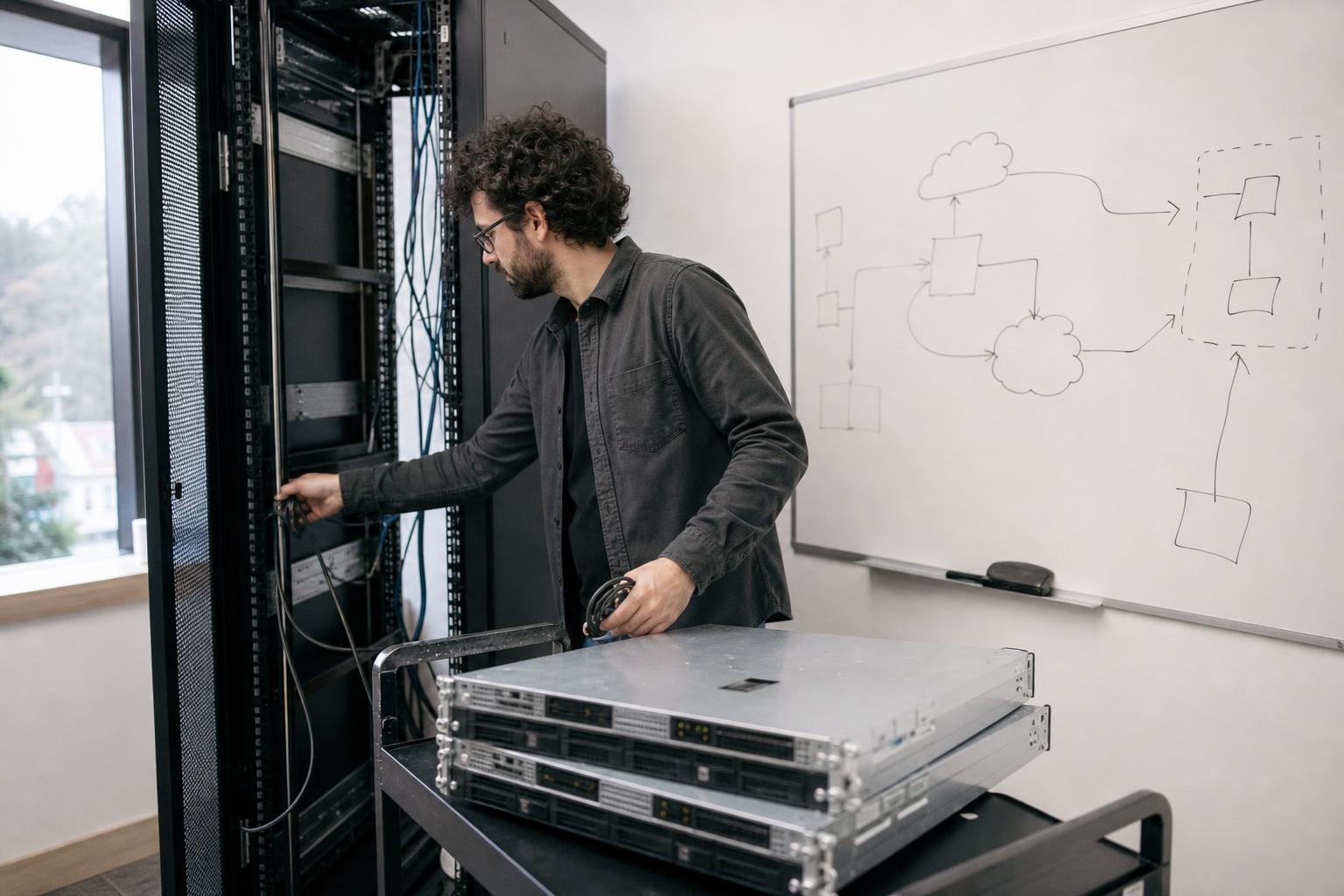
Why data backup matters for Los Angeles businesses
Data loss events—whether from ransomware, hardware failure, user error, or natural disaster—can halt operations and threaten business continuity. According to LosAngeles.IT directory data, 22 providers currently offer backup and disaster recovery services across the metro area, serving businesses from sole proprietors to mid-market firms.
The Los Angeles IT services sector employed 30,500 workers as of July 2026, according to the U.S. Bureau of Labor Statistics, down 6.4 percent from 32,600 a year earlier. Even as employment has contracted, demand for data protection services remains consistent: businesses in regulated industries face compliance mandates, while growth-stage companies need scalable backup infrastructure that can expand with their operations.
What backup services actually include
Data backup services typically bundle several components. Cloud backup automatically replicates files, databases, and application data to off-site storage—commonly AWS S3, Azure Blob Storage, or provider-managed data centers. Local backup appliances create on-premises copies for fast recovery of recent changes. Image-based backup captures entire server states, enabling rapid restoration of complete systems rather than individual files.
Disaster recovery planning defines recovery time objectives (RTO) and recovery point objectives (RPO)—how quickly systems must return and how much data loss is acceptable. Providers test recovery procedures quarterly or annually, documenting runbooks and validating that backups can actually be restored under pressure.
Most offerings include continuous data protection (CDP) for critical databases, which captures every transaction in near-real-time, and versioned retention, keeping multiple historical snapshots so businesses can recover from corruption discovered days or weeks after it occurred.
Common deployment models
Cloud-only backup routes all data to hyperscale storage, offering unlimited capacity and geographic redundancy. This model suits businesses with reliable internet, modest data volumes, or applications already running in public cloud. Monthly costs typically start at $50 to $150 for small workloads and scale with the amount of data under protection.
Hybrid backup combines on-premises appliances with cloud replication. The local device provides fast recovery for recent changes—minutes instead of hours—while cloud copies protect against site-level disasters. Mid-market firms often choose this model when they need sub-hour RTOs and operate bandwidth-constrained offices. Upfront appliance costs range from $2,000 to $10,000, plus monthly cloud storage fees.
Replicated infrastructure, sometimes called hot standby or disaster recovery as a service (DRaaS), keeps duplicate servers running in a secondary location. When primary systems fail, workloads failover to the replica environment within minutes. This approach is common in healthcare and finance, where downtime directly affects revenue and regulatory standing.
Geographic and industry distribution
LosAngeles.IT directory data shows backup providers concentrated in neighborhoods with higher densities of commercial real estate. Downtown LA lists the most providers, followed by Culver City, Santa Monica, and Century City. The Westside and South Bay corridors—spanning El Segundo, Inglewood, Torrance, and Long Beach—also show strong coverage.
In the San Fernando Valley, businesses in Burbank, Glendale, Sherman Oaks, Woodland Hills, and Van Nuys have access to local providers. Coverage extends north to Santa Clarita and Calabasas, and east to Pasadena and Arcadia.
Industry demand varies by regulatory exposure. Legal practices require secure retention of client files and email for ethics compliance. Healthcare organizations must meet HIPAA requirements for electronic protected health information (ePHI), which mandate encrypted backup and documented recovery testing. Entertainment and media companies protect large video and project files, often integrating backup with post-production workflows.
How backup integrates with broader IT services
Backup is rarely deployed in isolation. Most providers bundle it within managed IT services agreements that include monitoring, patching, and help desk support. Businesses paying flat monthly fees for comprehensive IT support typically receive backup configuration, monitoring, and recovery assistance as part of the package.
Cybersecurity and backup intersect when ransomware strikes. Immutable backups—copies that cannot be altered or deleted, even by administrators—enable recovery without paying ransom. Providers often layer backup behind separate authentication, ensuring attackers who compromise production credentials cannot destroy recovery copies.
Cloud migration projects frequently trigger backup redesigns. A business moving file servers to Microsoft 365 or applications to AWS or Azure typically re-evaluates retention policies, adjusts RTO/RPO targets, and selects backup tools native to the new platform. Providers offering cloud migration services usually include backup architecture as a migration workstream.
Evaluating providers and setting expectations
Businesses selecting a backup provider should request documentation of recent recovery tests, including timestamps and confirmation that restored data matched production. A provider that cannot demonstrate successful recovery within the past 90 days may not have validated their procedures under realistic conditions.
Pricing transparency matters. Some vendors quote storage costs but obscure egress fees—charges for downloading data during recovery. Others include monitoring and management labor in monthly fees, while competitors bill recovery events separately. Businesses should clarify whether the quoted price covers storage, bandwidth, software licensing, and support labor, and whether recovery assistance incurs additional charges.
Geographic redundancy provides protection against regional outages. Backup data stored solely in Los Angeles data centers remains vulnerable to seismic events or widespread power failures. Providers using multi-region cloud storage or replicating to facilities outside California offer stronger disaster resilience.
Compliance alignment is essential for regulated businesses. A healthcare provider must confirm that backup infrastructure meets HIPAA technical safeguards—encryption at rest and in transit, access logging, and business associate agreements. Legal practices subject to state bar ethics rules should verify that backup includes email and client files, with retention periods matching regulatory mandates.
Current market employment context
The U.S. Census Bureau's County Business Patterns reported 4,424 computer systems design and related services establishments in Los Angeles County in 2023, employing 33,806 workers with an average annual payroll of $129,759 per employee. These firms generated $4.39 billion in annual payroll.
The U.S. Bureau of Labor Statistics reported computer systems design and related services employment at 30,500 in July 2026, down from 32,600 a year earlier. The broader professional and business services sector employed 448,100 workers in July 2026, a 1.1 percent decline from 453,300 in July 2025.
Average hourly earnings for private-sector workers in the Los Angeles–Long Beach–Anaheim metro reached $41.34 in July 2026, up 4.0 percent from $39.76 a year earlier, while average weekly hours stood at 33.1, down 1.8 percent from 33.7.
Data & methodology
Employment and establishment figures are drawn from the U.S. Census Bureau's County Business Patterns (2023) and the U.S. Bureau of Labor Statistics' State and Metro Area Employment, Hours, and Earnings (July 2026). Provider counts, service distribution, and neighborhood coverage are based on LosAngeles.IT directory data, collected September 2026. Businesses seeking to compare providers can review verified listings and service coverage across Los Angeles neighborhoods in the directory.
Frequently asked questions
How many backup and disaster recovery providers serve Los Angeles?
According to LosAngeles.IT directory data, 22 providers offer backup and disaster recovery services across the Los Angeles metro area as of September 2026.
What is the difference between backup and disaster recovery?
Backup creates copies of data for restoration after loss, while disaster recovery encompasses the broader process of restoring entire systems and operations after a major outage, including tested procedures, recovery time objectives, and failover infrastructure.
How much do data backup services typically cost?
Cloud-only backup typically starts at $50 to $150 per month for small workloads and scales with data volume. Hybrid solutions add upfront appliance costs of $2,000 to $10,000 plus ongoing cloud storage fees. Pricing varies based on data volume, retention requirements, and whether recovery assistance is included.
Which Los Angeles neighborhoods have the most backup service providers?
Downtown LA has the highest concentration of backup providers in the LosAngeles.IT directory, followed by Culver City, Santa Monica, and Century City. Significant coverage also exists in El Segundo, Inglewood, Torrance, Long Beach, Burbank, and Glendale.
What should businesses look for when evaluating backup providers?
Businesses should request documentation of recent recovery tests, clarify pricing for storage and recovery events, verify geographic redundancy beyond Los Angeles, and confirm compliance alignment for regulated industries such as healthcare and legal services.