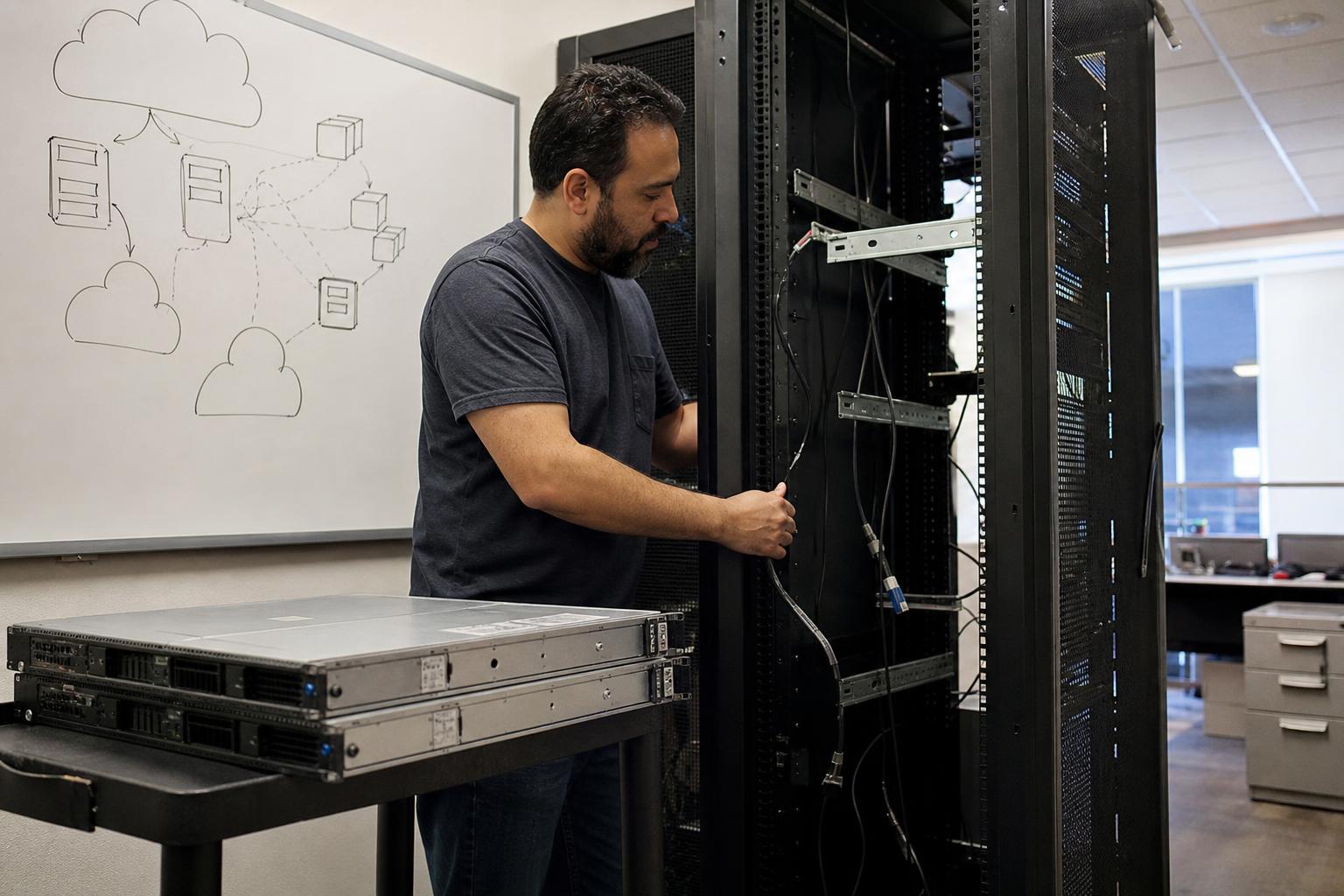
Core service components
Managed IT services in Los Angeles combine multiple technology disciplines under one contract. According to LosAngeles.IT directory data, 38 local providers offer managed IT services, the most widely available category in the market. Most managed service providers (MSPs) structure their offerings around five core components: help desk and user support, cybersecurity and compliance, cloud infrastructure management, backup and disaster recovery, and strategic IT consulting.
Help desk support forms the foundation. Users contact a service desk via phone, email, or ticketing portal for software troubleshooting, password resets, access issues, and application errors. The IT support function typically operates during business hours, with some providers offering after-hours coverage for critical issues.
Cybersecurity services include endpoint protection, firewall management, patch management, email filtering, and security monitoring. Providers in sectors such as legal and healthcare often add compliance-specific controls to meet regulatory requirements.
Cloud infrastructure management covers Microsoft 365 administration, cloud migration planning and execution, and ongoing management of cloud workloads. Many Los Angeles businesses rely on MSPs to handle Office 365 licensing, SharePoint configuration, and Azure or AWS resource management.
Backup and disaster recovery services ensure business continuity. Providers configure automated backups, test restore procedures, and maintain documentation of recovery time objectives and recovery point objectives.
IT consulting and vCIO services add strategic planning to the operational mix. A virtual chief information officer (vCIO) meets with business leadership quarterly or monthly to align technology investments with business goals, plan hardware refresh cycles, and evaluate new software.
Service delivery models
Most Los Angeles MSPs offer three engagement models: fully managed, co-managed, and project-based support.
Fully managed services transfer day-to-day IT operations to the provider. The MSP assumes responsibility for monitoring, maintenance, user support, and vendor management. This model suits organizations without internal IT staff or those looking to replace an overburdened one-person IT department.
Co-managed services supplement an existing internal IT team. The MSP handles specific functions—such as after-hours monitoring, security operations, or cloud administration—while the internal team manages strategic projects and business-application support. This arrangement is common among mid-market companies in entertainment and finance that maintain specialized internal expertise but need broader coverage.
Project-based support operates on a time-and-materials or fixed-bid basis for defined initiatives: office relocations, network upgrades, software migrations, or compliance audits. Some providers blend project work with ongoing managed services, others offer projects as a standalone option.
Geographic service patterns
LosAngeles.IT directory data show provider concentration varies significantly by neighborhood. Downtown LA hosts 29 providers, the highest count in the region, followed by Culver City with 21 and Burbank with 15. Santa Monica, Inglewood, West LA, and Glendale each have double-digit provider counts.
Westside neighborhoods such as Century City and Beverly Hills show moderate provider presence, while Playa Vista and West Hollywood currently have no directory-listed managed-service providers, representing coverage gaps for businesses in those areas.
Valley locations including Sherman Oaks, Woodland Hills, Van Nuys, and Northridge have regional provider representation. South Bay areas such as El Segundo, Torrance, and Long Beach also maintain active managed-service markets.
Pricing and contract structure
Most managed IT contracts use per-user-per-month or per-device-per-month pricing. Entry-level plans covering help desk, basic monitoring, and patch management typically start between $100 and $150 per user per month. Comprehensive packages that include advanced security, compliance support, and vCIO services range from $175 to $300 per user per month. For detailed pricing breakdowns, see the managed IT services cost guide.
Contracts typically run one to three years. Month-to-month agreements exist but carry higher per-unit pricing. Most MSPs require a minimum user or device count—commonly 10 to 20 seats—to ensure engagement profitability.
Service-level agreements define response times, resolution targets, and uptime commitments. Standard SLAs specify 15-minute response for critical issues, one-hour response for high-priority tickets, and four-hour response for routine requests. Providers measure performance monthly and some offer service credits when targets are missed.
Industry and regulatory considerations
Certain Los Angeles industries require specialized managed IT services. Healthcare organizations must work with MSPs experienced in HIPAA compliance, including business associate agreements, encryption standards, and audit-log retention. Law firms need providers familiar with attorney-client privilege, matter-centric access controls, and legal-hold procedures for eDiscovery.
Financial services and accounting firms require compliance-focused IT that addresses Gramm-Leach-Bliley Act requirements, SOC 2 audits, and payment-card-industry data security standards. Aerospace and defense contractors need MSPs cleared to handle controlled unclassified information under NIST 800-171 and, in some cases, ITAR compliance.
Manufacturing and logistics companies often need operational-technology expertise in addition to traditional IT services, particularly when managing networked production equipment or warehouse-management systems.
Employment and market context
The U.S. Bureau of Labor Statistics reports that computer systems design and related services employment in the Los Angeles–Long Beach–Anaheim metro area totaled 30.5 thousand jobs in July 2026, down 6.4 percent from 32.6 thousand jobs in July 2025. The broader professional and business services sector employed 448.1 thousand workers in July 2026, a decline of 1.1 percent year over year.
The U.S. Census Bureau's County Business Patterns data for 2023 counted 4,424 establishments in Los Angeles County classified under computer systems design and related services, employing 33,806 workers with an average annual payroll of $129,759 per employee. Establishments with fewer than five employees accounted for 3,440 of the total, while 61 establishments employed between 50 and 99 workers.
Evaluating managed service providers
Businesses evaluating MSPs should assess technical capability, service scope, industry experience, and operational transparency. Request client references in similar industries and ask about average ticket resolution times, escalation procedures, and staff turnover rates.
Review the provider's technology stack and tooling. Modern MSPs use remote monitoring and management (RMM) platforms, professional services automation (PSA) systems, and security information and event management (SIEM) tools to deliver consistent service. Ask whether the provider maintains a security operations center or partners with a third-party SOC.
Understand the onboarding process. Effective MSPs conduct a full IT assessment, document existing infrastructure, identify security gaps, and create a transition plan before assuming operational responsibility. The onboarding period typically spans 30 to 90 days depending on environment complexity.
Clarify vendor-management responsibilities. Some MSPs manage relationships with internet service providers, software vendors, and hardware manufacturers as part of the managed-services agreement; others require the client to maintain those relationships directly.
Data & methodology
Employment and establishment figures come from the U.S. Bureau of Labor Statistics State and Metro Area Employment, Hours, and Earnings program and the U.S. Census Bureau County Business Patterns survey for 2023. Provider counts, service availability, and neighborhood distribution reflect LosAngeles.IT directory data current as of August 2026.
Frequently asked questions
What is the difference between managed IT services and break-fix support?
Managed IT services operate on a flat monthly fee and include proactive monitoring, maintenance, and strategic planning. Break-fix support bills hourly or per incident only when something breaks, with no ongoing monitoring or preventive maintenance.
How many managed IT providers serve Los Angeles County?
According to LosAngeles.IT directory data, 38 providers offer managed IT services in Los Angeles, with Downtown LA hosting 29 providers and Culver City hosting 21.
Do managed service providers support both on-premises and cloud infrastructure?
Yes. Most Los Angeles MSPs manage hybrid environments, including on-premises servers, cloud workloads in Azure or AWS, and SaaS applications such as Microsoft 365.
What is a vCIO and is it included in managed IT services?
A virtual chief information officer (vCIO) provides strategic IT consulting, technology planning, and vendor evaluation. It is included in comprehensive managed-service packages but may be an add-on in entry-level plans.
Are managed IT services suitable for small businesses?
Yes. Many providers offer plans for businesses with as few as 10 users, covering help desk, security, and cloud management under a predictable monthly fee that replaces the cost of a full-time IT hire.